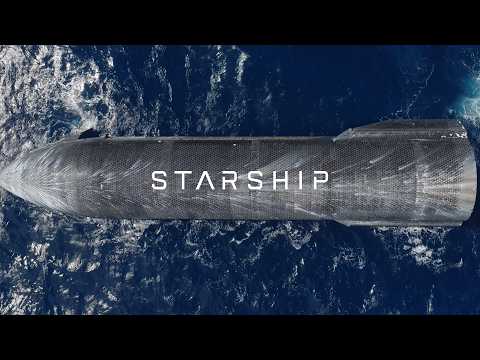
You are listening to a Podhoc podcast — a platform where anything can be turned into a Podcast to Learn in Motion.
The holy grail of rocketry, a fully reusable rocket, is not a new idea, but one that has been pursued for a very long time. For various reasons, some began to believe it was an impossible dream and abandoned the pursuit of reusability. However, it is precisely this reusability that will open up the solar system to us.
If we can demonstrate that complete reusability is achievable, then the possibilities for space exploration become limitless. The images from a test flight show a rocket reentering the atmosphere, a critical phase where every air molecule hitting it at Mach 25 acts like a bullet. This immense energy must dissipate, and it does so by heating up the rocket.
During this peak heating phase of reentry, the rocket experiences maximum entry dynamic pressure. The vehicle's flaps are designed to take control, guiding it through this intense period. The success of such a maneuver is awe-inspiring, with the entire rocket returning intact and intact.
The concept of reusable rockets has been a cornerstone of SpaceX's development from the company's inception. Initially, the focus was solely on achieving liftoff, with reusability being a secondary concern. However, early in the program, leadership recognized the necessity of bringing the rocket back safely.
This led to the development of Grasshopper, an experimental test vehicle designed to master vertical takeoff and landing. The initial Grasshopper flights were very short, low-altitude hops, barely lifting off the ground. These were referred to as "baby hops" and "bunny hops," establishing the foundational skills for controlled descent.
The Grasshopper team operated like a smaller, more experimental unit within SpaceX itself. They tackled unconventional challenges and tasks for which they weren't formally trained. Their primary objective was to understand how to navigate the complex aerodynamic stages of reentry and successfully execute a landing.
At the time, the idea of landing a rocket of that size after it had returned from orbit seemed almost fantastical. The first hurdle was to convince the SpaceX team that such a feat was even possible. Once that internal consensus was achieved, the engineering effort shifted to meticulously planning and executing the necessary steps.
Following the success of the Grasshopper program, the next critical step was to prove that an orbital rocket could reach space and then return for a landing. This would solidify the viability of reusability for operational missions. While thorough planning is essential, a crucial 10% of understanding can only be gained through practical attempts.
The company experienced three consecutive landing attempts with unexpected failures, yet each attempt brought them closer to their goal. One such mission, CRS-7, was a resupply mission for NASA. NASA had placed considerable trust in SpaceX during its formative years, and their support was instrumental in the company's survival.
During the CRS-7 mission, there were multiple warnings indicating a non-nominal flight. A critical failure occurred, leading to the self-destruction of the rocket. This was the first failure of the Falcon 9, which had previously maintained a perfect record, leaving everyone in shock.
This unexpected setback served as a significant wake-up call for the entire company. Many individuals dedicated to reusability were compelled to focus intensely on resolving the underlying issues. The company had to halt operations to thoroughly investigate and rectify the problems that led to the failure.
Consequently, the Orbcomm mission became not just a return to flight for SpaceX, but also an ambitious attempt to land the rocket back at Cape Canaveral on a landing pad. The tension during the countdown was palpable, with all eyes on the data streams for any anomalies.
There were some unusual readings during the second stage, possibly related to helium or nitrogen leaks, or even just residual water. The team discussed the situation, debating whether to proceed with the landing attempt. Ultimately, they decided to move forward with the plan.
The stage one boost back burn commenced, with telemetry and power readings remaining healthy. A tracking camera on the rocket captured a truly remarkable image of the engine igniting during the landing sequence. This visual was so astonishing it left the observers speechless.
The rocket descended, its landing legs deployed, and then, improbably, it landed successfully. Cheers and exclamations of disbelief filled the air as the Falcon 9 touched down on Landing Zone 1. The successful landing was considered an almost impossible achievement by many.
The period following the successful landing involved progressively improving the rocket's performance. The objective was to shorten the landing burn duration, thereby maximizing payload capacity. This required continuous pushing of technological boundaries.
While Falcon achieved partial reusability, it demonstrated that full reusability was within reach, a goal that Starship aims to realize. The recovery operation for Starship involves a vessel positioned off the coast of Western Australia, a remote location. This marked the first time a ship was connected to the Starship rocket.
The Starship, despite being described as a "bad boat," possesses significant buoyancy for its size, resulting in a very shallow draft. Its large sail area allows it to move with even minimal wind or prodding. This characteristic made it challenging to control during the recovery process.
The recovery team struggled as the rocket began to drift, fighting against the desired course. The vehicle seemed intent on floating away into the ocean, resisting every attempt to bring it closer. The conditions, including rough seas and strong winds, created a relentless battle.
The situation evolved into a desperate struggle for the smallest victories, with progress often undone within an hour. Facing a lengthy tow back to mainland Australia, the team realized a pivot was necessary to salvage the vehicle. They were making extremely slow progress, barely countering the drift.
A simple shoestring tied to the back of the vehicle eventually proved effective, along with favorable wave conditions assisting the tow for a significant distance. This ordeal provided invaluable, albeit hard-won, knowledge, hopefully never to be needed again. The sight of the recovered Starship was met with astonished disbelief.
The fundamental challenge in returning the Starship second stage is surviving the extreme heat of reentry. Extensive work was dedicated to the heat shield's design, intended to withstand immense temperatures. However, the tiles must also endure the violent vibrations and acoustic forces of ascent.
The Starship second stage's design is a departure from previous orbital stages, starting from a clean slate. A direct application of Falcon booster landing techniques would have resulted in the destruction of its engines during reentry. Even advanced material science wouldn't have prevented its disintegration.
Flight testing is often the most effective method for evaluating heat shield tiles. The Starship program exemplifies an iterative approach, with the tiles representing a significant culmination of developmental effort over several years. This required a fundamental reimagining of the thermal protection system.
The scale of Starship, being the largest orbital vehicle ever constructed, necessitated reinventing the wheel for its TPS program. The re-entry heat load can be conceptualized like a river; if it flowed perpendicularly, the tiles would be destroyed. However, its downward flow allows the tiles to resist complete destruction.
The primary goal is to prevent heat transfer from the tile surface to the rocket's internal structure. The white material of the tiles is an exceptionally effective insulator, capable of withstanding direct torch blasts without radiating significant heat. Essentially, these heat shield tiles are a highly sophisticated form of glass.
A key challenge lies in the sheer number of tiles; approximately 20,000 opportunities exist for error. Therefore, the installation process must be meticulous to ensure each tile is correctly affixed. This detailed work requires extreme attention to millimeters and the smallest of measurements.
The recovery mission to Australia presented an unexpected deployment for some employees, who were suddenly tasked with passport requirements for an international trip. What began as a typical workday at Starbase transformed into an overseas operation, waking up next to a Starship in the Indian Ocean.
The sight of the heat shield tiles glowing was a testament to the intense heat they endured. This recovery mission represented a tangible step towards achieving full reusability. The experience was described as one of the best work mornings ever, involving divers and tile retrieval on Christmas Island.
The current vehicle configuration limits inspection capabilities in certain areas, making vehicle rotation a key objective. This maneuver, using rigging and lift bags, would gently roll the vehicle to allow access for inspection. The TPS team anticipated this being a valuable opportunity for data collection.
The success of this endeavor relies on a diverse range of skills, as the work is unprecedented. SpaceX employees from various departments, including EHS, recovery, structural engineering, naval architecture, and the tile team, were involved. Witnessing the rocket tip over and survive was met with amazement and rejoicing.
The data gathered from this recovery is considered a goldmine, potentially accelerating design improvements by months. It provides an opportunity to fix existing issues and uncover the next layer of complexity in achieving full vehicle reusability. The team is eager to analyze the recovered components.
The plan for the next day involved transporting Ship 40 onto the deck of the Forte, a heavy-lift vessel. After securing it in a cradle, the Forte would deballast, allowing Ship 40 to rest securely for its eventual return journey to Starbase. This rapid mobilization showcased the team's adaptability.
The cradle was designed and assembled while the Forte was en route, demonstrating remarkable resourcefulness. Despite its scrappy appearance, the setup was robust and capable of supporting the mission. The process of raising and positioning the vehicle required precise coordination and tension control.
The vehicle was carefully maneuvered directly above the cradle. Once teams confirmed its stability, the Forte would begin deballasting, carefully lowering the rocket. This critical phase required strict adherence to safety protocols, with no personnel permitted on the deck.
It had been just over a month since the rocket's flight, and two days since it was brought onto the barge dry. The data recovered from this mission was considered an absolute success, providing crucial insights for future improvements. Every discovery made with Ship 40 would directly inform the heat shield design for Ship 41.
The critical next step for the program is to return the ship to the launch site, a feat heavily reliant on the heat shield's performance. The core potential of this endeavor is to fundamentally alter humanity's relationship with space, making it more accessible for everyone. We are on the verge of redefining the difficulty of reaching Earth orbit.
A significant development from this flight was the simulation of a tower catch in the middle of the ocean at the mission's conclusion. The landing guidance algorithms executed maneuvers requiring extreme precision, successfully positioning the rocket as if a tower were present. This demonstrated that, had a tower been available, the rocket would have been caught.
Thank you for listening to this Podhoc podcast.